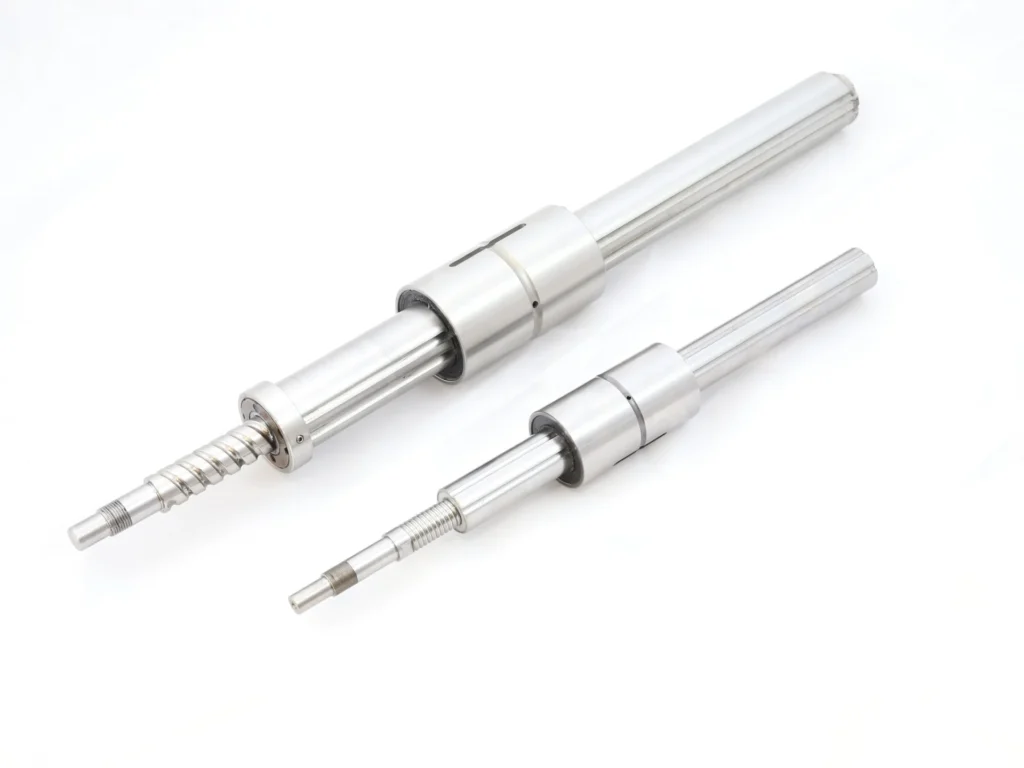


Integrated ballscrews: For transverse load-absorbing linear systems in CNC & automation
The Integrated ballscrews from PGM Motion are an innovative combination of a conventional ball screw and a ball spline. They are ideal for applications where transverse loads occur in addition to axial forces. This unique design was developed to overcome the limitations of conventional ball screw systems.
By grinding the ball screw return channels directly into the hollow shaft of the torque shaft, we create a system with exceptionally high inherent rigidity and flexibly selectable load ratings. The result is compact, robust drive units with a long service life. Specifically designed for CNC machines, automation, and high-precision linear motion solutions.
Operating Principle & Design
- Combined structure: An integrated ballscrew combines the torque-transmitting shaft profile with the force transmission of a ball screw.
- Integrated return channels: The ball return channels are ground directly into the hollow shaft, eliminating the need for external return modules.
- Transverse load capability: Thanks to this design, the system can absorb transverse loads while simultaneously transmitting axial force -a function that conventional ball screws cannot provide.
- High structural rigidity and load capacity: The rigid integration of the components creates a system with high stiffness and strong load ratings, making it ideal for demanding applications.
The system is developed in close cooperation with leading mechanical engineering partners from the CNC and robotics industries.
Why Integrated ballscrews?
- Greater Stability in a Compact Design
The integrated design saves installation space and reduces mechanical interfaces. Ideal for space-critical applications such as gripper axes. - Reduced System Errors
Fewer connection points and increased rigidity reduce the likelihood of errors, resulting in more precise motion. - High Load Capacity
Selectable load ratings allow adaptation to different load profiles. Ideal for payloads and dynamic applications. - Versatile Application Areas
Whether in machining centers, assembly systems, or automation solutions – torque ball screw drives deliver reliable performance, especially in applications where transverse loads occur. - Compatible with Common Systems
This technology can be easily integrated into existing linear systems and combined with established drive solutions.
Request Technical Consultation Now – our engineering team will support you in the selection and configuration of your integrated ballscrews.
Download our catalog here for free:
FAQ – Frequently asked questions about integrated ballscrews
1. What transverse loads are permissible?
The permissible transverse loads depend on the design and size of the system. As a planning guideline, a transverse load share of approximately 10–20% of the nominal axial force is often used. For final design, always consider datasheet limits and appropriate safety factors.
2. Are integrated ballscrews suitable for high speeds in CNC machines?
Yes, provided that the shaft, bearing arrangement, mass balancing, and lubrication are properly designed. Precisely manufactured, internally ground return channels minimize imbalance and vibration even during dynamic axis movements.
3. Can these drives be backdrivable?
With high efficiencies and larger leads, backdriving is generally possible. In safety-critical applications, a holding brake or a servo with sufficient holding torque is recommended.
4. What is the advantage over standard ball screws under transverse loads?
Standard ball screws are primarily designed for axial loads. The combined design with a torque shaft enables integrated transverse load absorption, increases stiffness, and reduces the number of components and interfaces—resulting in higher precision and robustness.
5. How do I select the right integrated ballscrew for my application?
Selection depends on several parameters, including required axial force, transverse load share, lead, size, and operating environment (e.g., temperature or lubrication conditions).
For individual projects, a free application assessment by our engineering team is recommended.
6. Which lubricants or coatings are recommended for operation?
For standard applications, synthetic long-life lubricants (e.g., NLGI 2) are typically used. For high-temperature or food-grade environments, PTFE, MoS₂, or dry-film coatings are also available.
Optionally, the screw drive can be equipped with an integrated solid lubricant layer to eliminate relubrication intervals.
7. Does PGM Motion support CAD integration or FEM-based design?
Yes customers can receive 3D CAD models (STEP, IGES, SolidWorks) and FEM-based load simulations upon request.
These help with integration into existing axis systems and with optimizing stiffness, resonance behavior, and dynamics.
Upon request, our design service can also provide individual assembly and load analysis reports.