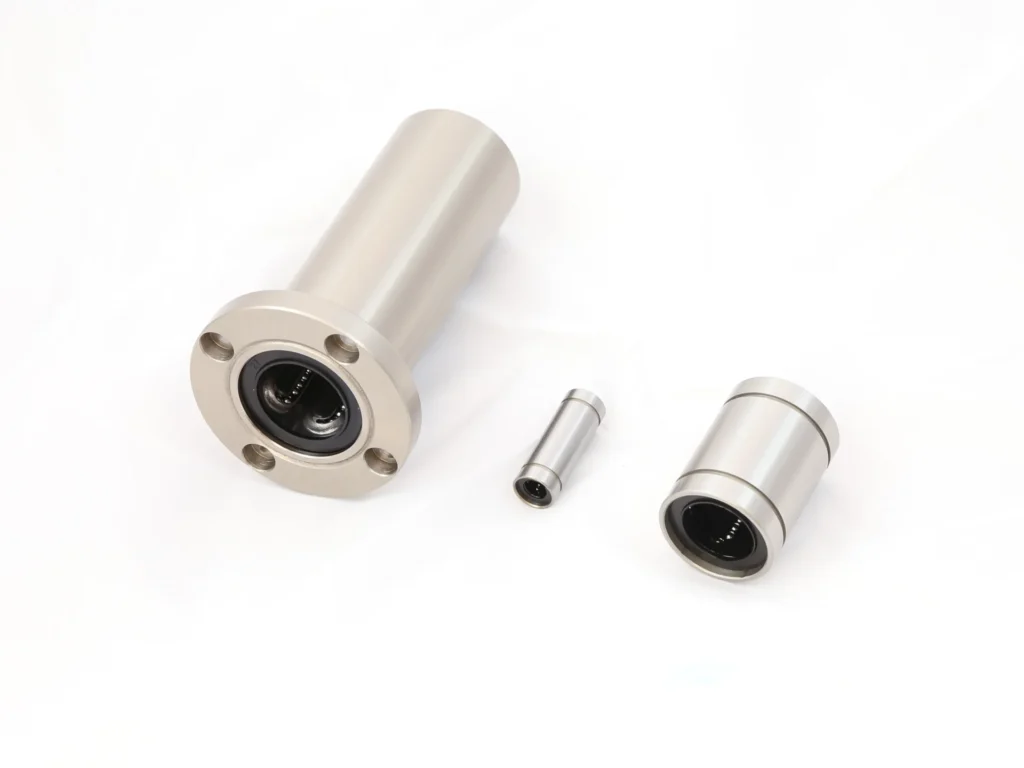


Ball bushes: Precise guidance for linear and rotational motion in linear technology
Ball bushes are highly precise guidance elements used between a shaft and a housing. They can be designed for pure linear motion or for a combination of linear and rotational movement. In combination with guide shafts, our ball bushes enable torsion-resistant, smooth motion without stick-slip or backlash.
Compared to conventional bushings with rotary bearings, specialized rotary ball bushes offer a significantly more compact design and higher precision. Typical applications include CNC machines, linear technology, linear rail modules, guide bushings for precision applications, as well as linear bearings and flanged plain bearing bushings.
All ball bushes from PGM Motion are developed and tested in Japan.
Each series undergoes functional and endurance testing according to internal quality standards to ensure maximum precision and repeatability.
With nearly 30 years of experience in linear motion technology, our engineers are specialists in backlash-free, durable guidance systems for industrial applications.
Technology & design of ball bushes
- Guidance component: The ball bush runs on a hardened precision shaft, guided within a bushing sleeve, ensuring minimal friction and smooth, consistent motion.
- Linear and rotational capability: Special designs allow the bush not only to move axially, but also to perform simultaneous rotational motion. Ideal for applications with combined movements.
- Torsion-Resistant design: Our ball bushes are engineered to remain twist-free under load, even during directional changes and cyclic motion, without generating backlash.
- Compact Dimensions: Thanks to optimized internal and external design and recirculating ball technology, our rotary ball bushes offer a space-saving alternative to conventional bearing systems with separate rotational components.
- High-Precision use in demanding systems: Whether in machine tools, transport and handling systems, or the semiconductor industry, our bushes are designed for long-lasting, jerk-free motion with maximum accuracy.
Your key advantages of using ball bushes
- Minimal backlash and high repeatability – Especially in precision axes for CNC machines, even the smallest deviations matter.
- Combined motion capability – When linear and rotational motion need to be combined in one system, ball bushes provide a clear solution.
- Compact design with high load capacity – Optimized construction allows high loads in confined installation spaces.
- Torsion-Resistant and stable under load – The bushes ensure smooth operation even under changing loads and motion profiles.
- Seamless integration into modern linear motion systems – Ideal for modules with linear rails, linear drives, or as part of complex linear bearing solutions.
Ball bushes compared: Plain bearings vs. Precision guidance systems
While conventional plain bearing bushings are typically suited only for slow, lightly loaded systems, ball bushes provide backlash-free precision motion even under high cycle rates and changing loads.
Especially in automation, robotics, and CNC technology, they form the foundation for precisely repeatable motion over long operating periods.
Typical applications at a glance
- CNC machines – axes with combined linear and rotational motion (e.g. rotary indexing tables)
- Linear motion technology & linear axes – positioning systems, handling modules, precision axes
- Guide bushing solutions in automated transport systems or semiconductor production
- Linear bearing or sliding element applications in confined spaces or with high motion quality requirements
- Transport and assembly systems – compact constructions with high repeatability
Our engineering team supports you in selecting the right ball bush! From standard to custom designs.
You will receive an individual quotation including CAD model, load capacity calculation, and technical recommendation.
Download application examples and catalog here:
FAQ – Frequently asked questions about ball bushes
1. When should I use a ball bush instead of a standard plain bushing?
A ball bush is recommended whenever precise, smooth motion with very low friction is required – especially with changing directions or rotational movement. For simple applications with low loads and slow motion, plain bushings may be a more cost-effective option.
2. How can I ensure proper guidance and avoid backlash in a ball bush?
Key factors include a hardened, straight guide shaft, correct alignment of the bush, consistent lubrication, and regular inspection. Backlash or jerky motion can result from misalignment, improper installation, or excessive loads.
3. What advantages do rotary ball bushes offer compared to conventional ball bushes with rotary bearings?
Rotary ball bushes provide a more compact design, reduced installation length, and an integrated solution for combined linear and rotational motion. This reduces the number of components and interfaces, improving system rigidity and service life.
4. What role do the bush, guidance, and lubrication play in service life?
Service life depends on proper installation (shaft and bush), suitable lubrication, and environmental conditions. Clean environments, proper sealing, and even load distribution also contribute significantly to durability.
5. Can ball bushes be combined with linear rails or linear guides?
Yes – ball bushes can be effectively combined with linear rails or linear guides, especially when an axis must perform both linear and rotational motion. Proper system design is essential: the bush handles rotation or combined motion, while the linear guide ensures precise guidance.
6. How do I choose the right ball bush for my application?
Selection depends on shaft diameter, load, duty cycle, and environmental conditions. The PGM Motion team provides technical support for proper sizing and configuration.
7. Which materials are available?
Our ball bushes are available in steel or stainless steel, with optional food-grade versions.
8. How are ball bushes lubricated?
Depending on operating temperature and environment, greases (e.g. NLGI 2) or dry lubricants can be used.
9. Are custom sizes or special designs available?
Yes, we manufacture custom versions on request, including modified lengths, flanges, seals, or tolerance fits – ideal for series production machines or retrofit projects.