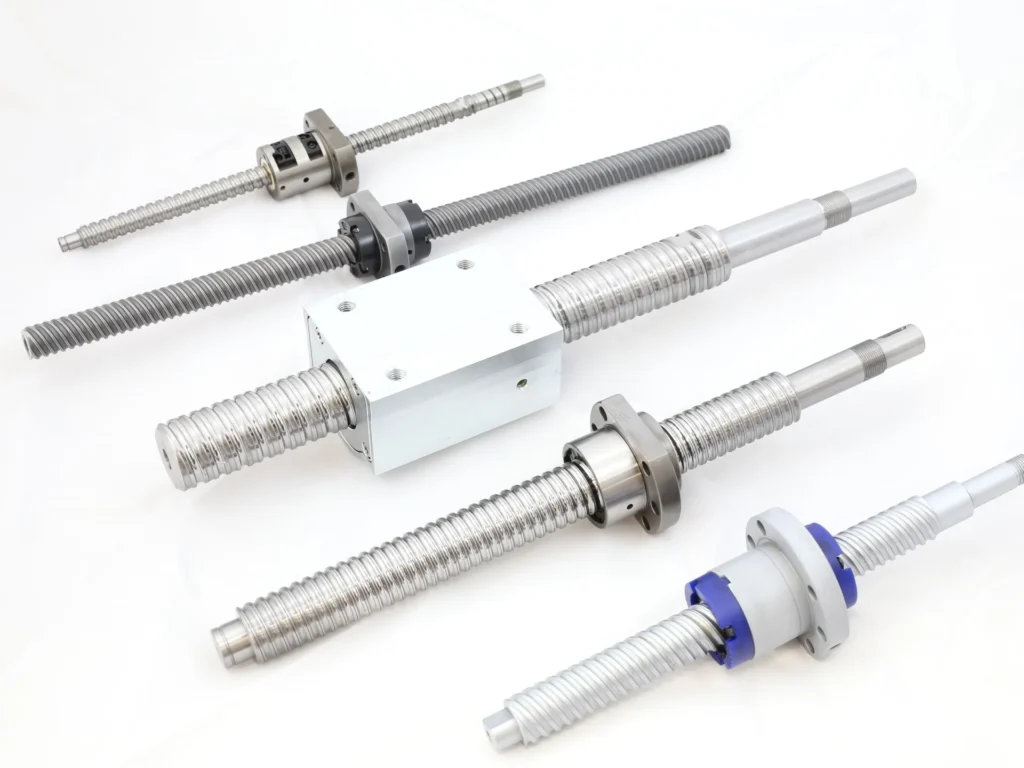


Ball Screws: precision drive solutions for CNC machines, linear motion systems & industry
Ball screws are a key component in nearly all areas of industry where mechanical motion plays an important role. From CNC machines and linear drives to complete linear motion systems. They convert rotational motion into highly precise linear movement, enabling high dynamics, load capacity, and repeatability.
Our ball screws are specifically designed to meet these demanding requirements, offering high precision, excellent rigidity, and long-term durability. They are ideal for applications in drive technology, linear axes, and a wide range of industrial motion systems.
Technology & functionality of ball screws
A ball screw primarily consists of a screw shaft and a ball nut, in which balls circulate. This arrangement converts the rotational motion of a motor or drive element into linear feed motion with very high efficiency and low friction.
Key Features:
- Highly precise thread pitch and recirculating ball mechanism
- Low friction and high efficiency – typically over 90%, compared to much lower values in conventional lead screws
- Screw options: ground, spiral-rolled, or rolled shafts with pitches ranging from 0.5 mm to 50 mm and nominal diameters from 4 mm to 150 mm
- Integration into linear axes, modular assemblies, or as part of complete drive systems
Why use ball screws in your machine?
- Precision & repeatability
In CNC machines or positioning systems with tight tolerances, exact motion is essential. Ball screws provide backlash-free, precise linear movement. - High load capacity & rigidity
Especially in drive systems or linear axes subject to dynamic loads and direction changes, ball screws offer a robust and durable solution. The material selection and design ensures a long service life. - Efficient conversion of rotation to Linear motion
High efficiency reduces energy consumption, lowers heat generation, and allows for a more compact overall drive solution. - Flexibility & Versatility
Whether single-spindle or multi-axis systems, prototype machines, or production lines – the design can be tailored to lead, load profile, speed, and operating conditions.
Find the Right Screw:
Our engineering team assists with the selection and design of your ball screw, including CAD models, load capacity calculation, and lifetime estimation.
Design, pitch, and accuracy class
The selection of pitch and accuracy class (P1 – P10 according to ISO 3408) depends on the application, traverse speed, and preload. For dynamic CNC axes, ground, preloaded ball screws are typically used.
For stationary applications, a rolled screw with a lower tolerance class is often sufficient.
Applications of ball screws
- CNC machines: Linear axes, Z-axes, rotary tables – where precise feed motion is required
- Drive technology: Feed drives, lifting modules, handling axes
- Linear motion & linear axes: Systems with high dynamics, high loads, and high precision
- Ball screw applications: Compact, high-performance solutions ideal for tight installation spaces and demanding requirements
FAQ – Frequently asked questions about ball screws
1. How do I choose the right pitch and diameter for my ball screw?
The pitch affects speed and force transmission: a larger pitch provides higher feed per revolution but reduces load capacity and accuracy. The diameter determines the bending stiffness of the screw. For linear axes or CNC machines, both must be matched to the load and motion profile.
2. Do ball screws require additional guidance?
Yes. A common misconception is that the ball screw alone provides guidance. In fact, rotation and linear movement must be supported by appropriate linear guides, since the screw itself does not provide radial guidance.
3. How can I assess the service life of my ball screw?
Service life is influenced by load, lubrication, environment, and workmanship. Well-protected and properly maintained screws can achieve thousands of operating hours before wear or backlash occurs.
4. What causes backlash or running issues in a ball screw?
Common causes include incorrect installation, insufficient lubrication, contamination, or incorrect preload.
5. Are ball screws better than rack-and-pinion or belt drives?
Ball screws are the optimal choice when high precision, repeatability, and stiffness are required, for example in CNC machines or measurement systems. They operate nearly backlash-free and enable highly accurate positioning.
Rack-and-pinion or belt drives are better suited for long travel distances or very high speeds where absolute precision is less critical. Belt drives are also more cost-effective and lighter but exhibit more backlash and lower stiffness.
In short:
For precise motion and high loads → Ball screw
For fast, long travels or cost-sensitive applications → Rack-and-pinion or belt drive