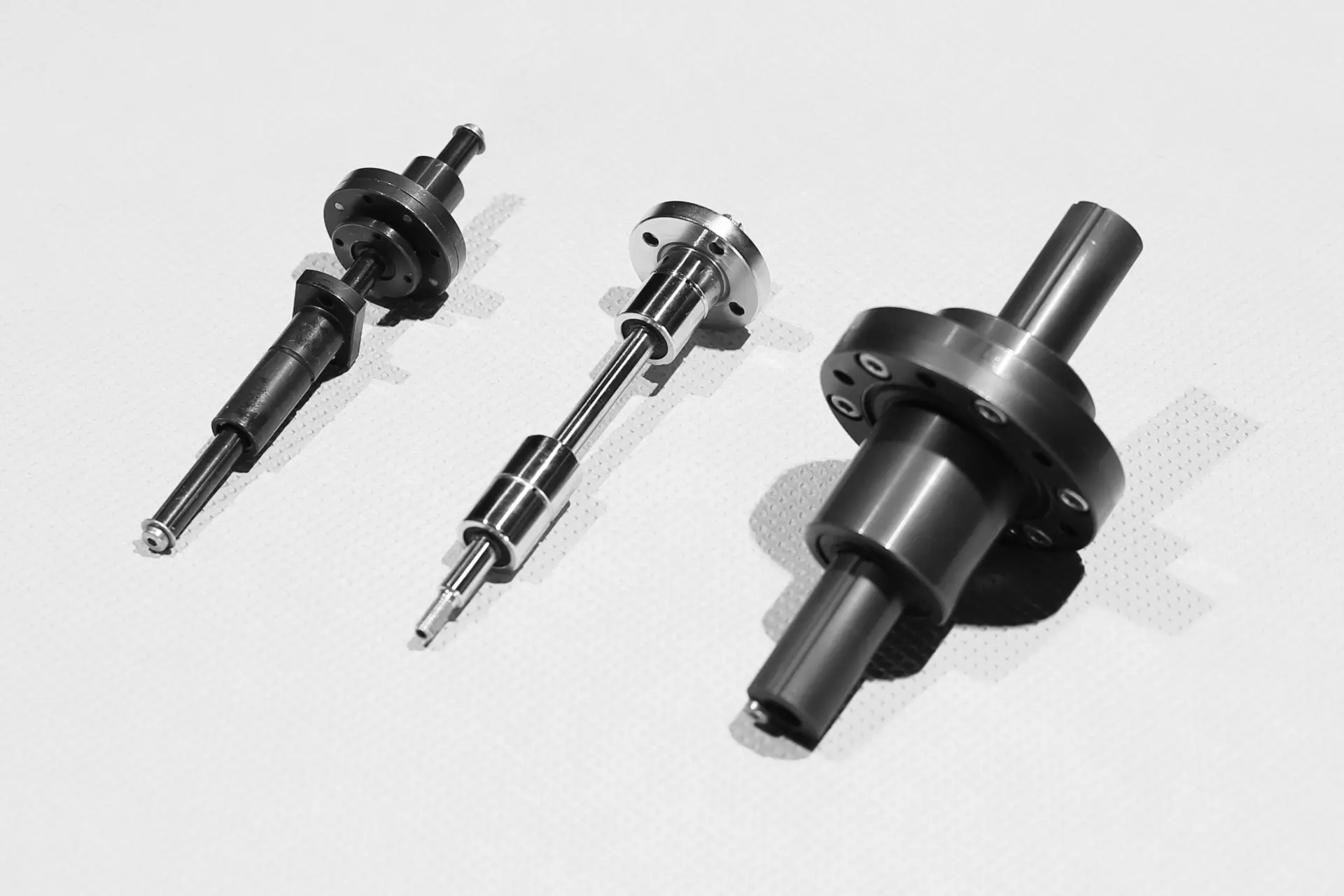


Ball splines: Guide units with transverse load and bending moment capacity for modern linear motion technology
The ball splines by PGM Motion are highly engineered guide units specifically designed to handle transverse loads and bending moments. Depending on the configuration, they enable either pure linear motion or a combination of linear motion and rotation. Thanks to their high precision and wide product range, they are ideal for applications in CNC machines, robotics, machine tools, transport systems, and pick-and-place automation.
In machine design, grooved shafts or torsion shafts are often used as torque-transmitting elements. Our ball splines provide an integrated solution: guidance, load transmission, and motion in a single system. This results in high rigidity, reliable movement, and long service life especially in demanding linear motion applications.
Technical principle & design features
- Transverse load and bending moment capacity: Unlike simple linear elements, our ball splines can directly absorb loads from lateral directions as well as bending moments.
- Linear and rotational motion: Depending on the design, the systems are configured either for pure linear motion or for a combined motion of linear travel and rotation, ideal for complex axes in CNC machines or handling systems.
- Grooved and torsion shaft integration: In many applications, a grooved shaft is used for axial guidance and torque transmission; when combined with torsionally rigid bodies, this results in a precise unit with minimal elasticity.
- High rigidity & precision: Thanks to high-quality materials and precise manufacturing, our ball splines ensure accurate guidance even under high dynamic loads.
Sizing and selection of a ball spline
When designing a ball spline, factors such as torsional rigidity, shaft diameter, bearing spacing, and bending moment limits are critical. Using modern FEA analysis and CAD simulations, we can determine the optimal parameters for dynamic axes and demanding motion systems.
Advantages of ball splines at a glance
- Compact integration of guidance and drive: Instead of separate components (such as parallel linear guides), we offer an integrated solution, saving space and simplifying installation.
- Higher load capacity: Conventional linear axes are often limited when forces act perpendicular to the direction of motion or when bending moments occur. Our systems are specifically designed to handle these loads.
- Flexibility for CNC & robotics: In modern CNC machines, robotic systems, and automated pick-and-place lines, ball splines improve precision and reduce system errors.
- Durability & efficiency: Fewer interfaces and fewer compromises in rigidity – this reduces wear, maintenance effort, and downtime.
- Suitable for a wide range of applications: Whether in tool changers, transfer units, gantry axis systems, or special-purpose machinery – the technology adapts to your specific requirements.
Have your system reviewed by our engineering team.
We provide a custom design including CAD data and load capacity calculations tailored to your requirements.
Application areas
- CNC machines: Spindle stroke systems, rotary table combinations, and hydraulic axes with transverse load requirements.
- Robotics: Axes with combined rotary and linear motion, end effectors, gripping systems, or handling units.
- Machine tools: Tool changer axes and axes with combined motion requirements.
- Transport & Pick-and-place systems: Modules with high dynamics and axes designed to handle transverse loads.
- Special-Purpose Machinery & Linear motion systems: Systems where conventional linear guides reach their limits.
PGM Motion – Precision built on experience
- Nearly 30 years of engineering expertise in linear motion and drive technology
- ISO 9001–certified manufacturing
- In-house testing laboratory and application support
Contact us now or download the technical datasheet and application examples.
FAQ – Frequently Asked Questions about Ball Splines
1. How do ball splines differ from conventional linear guide rails?
With conventional linear guides or linear rail systems, the primary focus is on axial guidance. Ball splines, on the other hand, combine linear guidance with torque and transverse load transmission. They allow axes to perform both rotational and translational motion within a single component. This is increasingly important in CNC machines and automation systems.
2. When is it beneficial to use a grooved shaft or torsion shaft?
A grooved shaft provides both torque transmission and motion guidance. A torsion shaft ensures high torsional rigidity under twisting loads.
When combined with a ball spline guide unit, machine axes can be designed to handle both translation and rotation -for example in machine tools or robotic axes.
3. Which factors are most important when sizing a ball spline?
Key parameters include:
- Axial and transverse forces as well as bending moments
- Rotational speed and stroke length
- Efficiency and friction losses
- Rigidity of the bearings and the axis
- Level of integration with the linear guide and drive system
Incorrect sizing can lead to resonances, premature wear, or insufficient repeatability.
4. Can ball splines be integrated into existing machines later on?
Yes, provided that installation space and interface dimensions are suitable.
However, the axis design, bearings, and guide systems must be carefully matched to the requirements of the linear motion system. Retrofitting is possible but usually requires careful planning and optimized installation.
5. How does the combination of a ball spline and linear guide affect service life and maintenance?
The integrated design reduces interfaces, bearing points, and the number of components, which lowers the number of potential failure sources.
As a result, service life and precision increase while maintenance requirements decrease. A clear advantage compared to solutions built from separate components.