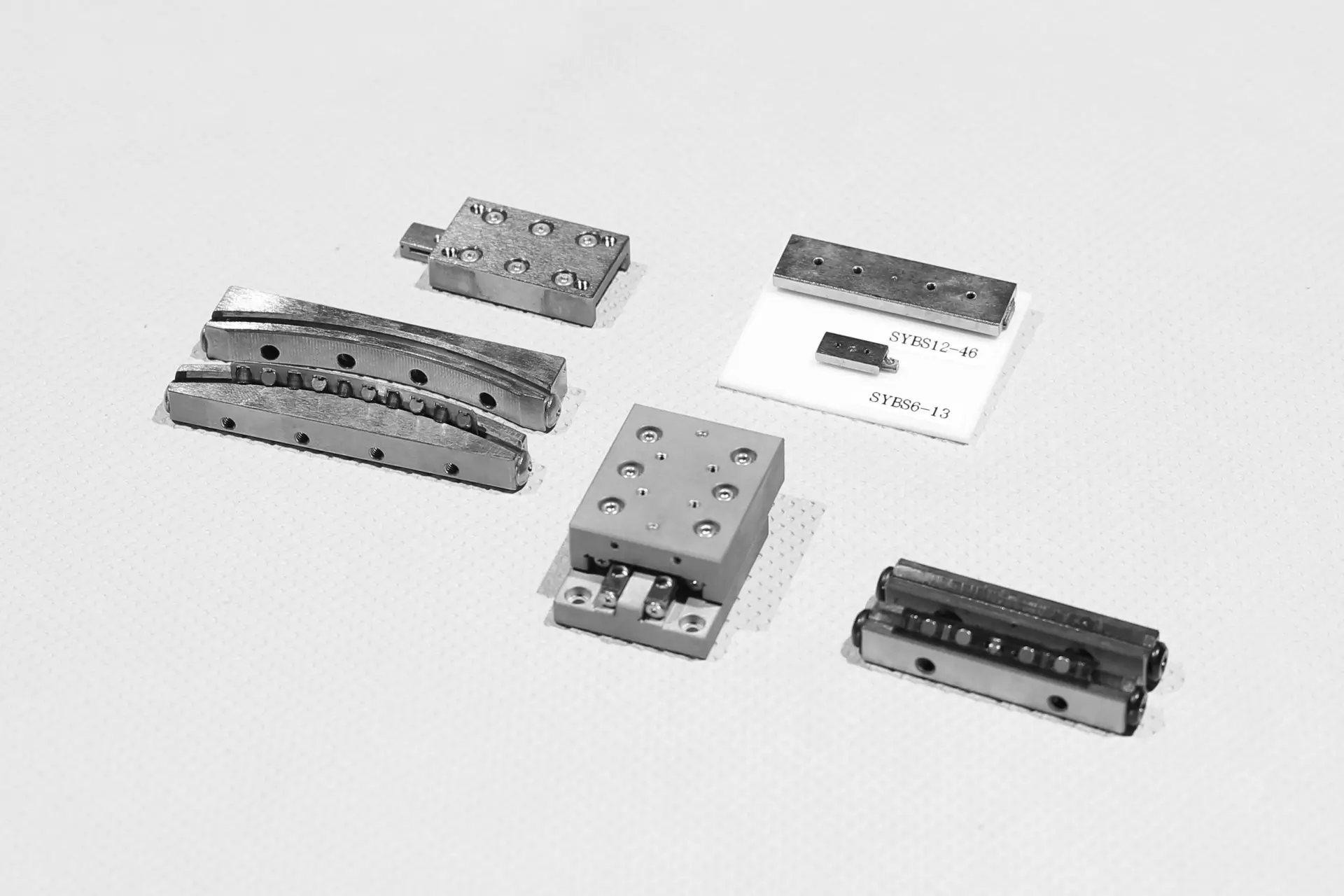


Limited-Stroke linear guides (Slide Ways): Linear motion units for optical, metrology, and manufacturing applications
Our limited-stroke linear guides (slide ways) are specialized linear motion systems designed for high-precision linear movement within a defined stroke range, without recirculating elements. They are ideally suited for applications requiring precise guidance over short travel distances, high repeatability, or controlled motion profiles.
Typical applications include optical engineering, metrology, automated assembly machines, electronics, and precision manufacturing systems.
For over 15 years, PGM Motion has been manufacturing limited-stroke linear guides in accordance with the tolerance standards of DIN 69051 and ISO 14728. Each unit undergoes individual inspection for dimensional accuracy, running precision, and surface quality.
The result is a high-precision linear motion technology trusted in advanced metrology and high-end manufacturing systems worldwide.
Variants & technical configurations of limited-stroke slide ways
Standard version
This version uses precision rollers as rolling elements in a linear guide system without recirculation. It is ideal for applications with a clearly defined stroke, low travel speeds, and high precision such as optical instruments or metrology equipment, where minimal movement and maximum repeatability are essential.
High-Precision linear stage
A high-precision linear stage equipped with a limited-stroke slide way enables backlash-free motion with extremely low friction. This variant is particularly suitable for automated assembly machines, electronics placement systems, and optical devices, where longer stroke lengths must be combined with consistently high guiding accuracy.
Curved guide (Arc guide)
The curved guide variant (often referred to as Type RV) is used when motion must follow a curved path rather than a straight line. The center of rotation remains constant, ensuring precise guided motion along the arc.
These curved precision guides are commonly used in optical and metrology systems, where motion along a defined curve must maintain maximum guiding accuracy.
Design & material selection of limited-stroke slide ways
The guideways are made of hardened tool steel or stainless steel, ensuring maximum dimensional accuracy, minimal friction, and long service life.
Optional configurations with ceramic rollers are available for applications in cleanroom or vacuum environments.
Why limited-stroke slide ways? Key Benefits at a Glance
- Precise guidance with defined stroke limits: Ideal for applications where motion is restricted to a specific range while maintaining maximum precision.
- No recirculation: Simpler mechanical design, resulting in reduced wear and lower friction.
- Precision roller guidance: Provides higher rigidity, improved positioning accuracy, and smooth, consistent motion.
- Curved and custom guide options: Arc guides and custom designs enable complex motion paths without changing the center of rotation.
- Wide range of applications: From electronics assembly, optical and metrology systems to heavy-duty roller guides and plasma cutting systems, limited-stroke linear guides offer versatile solutions.
- Compact design: Enables high-precision motion even in restricted installation spaces or low-profile designs (e.g., flat guide configurations).
| Guide Type | Characteristics | Benefits | Typical Application |
| Flat Guide | Compact, low friction | Space-saving, low maintenance | Precision systems with limited installation space |
| Cross Roller Guide | Rollers arranged in a cross pattern | High rigidity, supports multi-directional loads | High-precision metrology and positioning systems |
| Ball Recirculating Guide | Ball recirculation | Long service life, suitable for longer strokes | Mechanical engineering, linear axes |
| Curved Guide (Arc Guide) | Curved precision raceway | Constant center of rotation | Packaging and automation technology |
| Shaft Guide | Shaft used as raceway | Simple design | Lightweight linear systems, automation |
Configure your ideal limited-stroke slide way or request technical consultation
Our engineering team supports you in the selection, sizing, and integration of limited-stroke linear guides for your specific application.
Get in touch now or download our application examples and product catalog.
FAQ – Frequently Asked Questions About Limited-Stroke Linear Guides (Slide Ways)
1. Which applications are suitable for limited-stroke linear guides without recirculation?
Limited-stroke linear guides without recirculation are ideal for applications where motion is restricted to a defined travel range such as metrology and optical devices, positioning stages with limited stroke, or automated assembly machines with a fixed travel path. Eliminating recirculation reduces friction and simplifies the overall system design.
2. When should I choose a curved guide instead of a straight linear guide?
A curved guide (arc guide) is the right choice when motion must follow a curved path while maintaining a constant center of rotation. Compared to conventional linear guides, it enables precise and smooth motion along a defined arc.
3. What should I consider when selecting a limited-stroke linear guide for high loads or lateral forces?
For applications involving high loads or significant lateral forces (e.g., heavy-duty roller guides, side roller guides, plasma cutting systems), the guide system must be properly designed. Key factors include stroke length, axial and lateral loads, system rigidity, rolling element type (rollers vs. balls), lubrication, and assembly accuracy.
4. How does the choice of guide type (flat guide vs. cross roller guide vs. profile rail guide) affect system performance?
A flat guide offers a compact design with moderate precision.
A cross roller guide provides very high rigidity, minimal backlash, and good load-carrying capacity in multiple directions—making it ideal for compact X-Y positioning systems.
A profile rail guide is suitable for linear motion with high load capacity and high speeds.
The optimal choice depends on the specific application (e.g., assembly, optics, heavy-duty systems).
5. What are the advantages of limited-stroke linear guides compared to standard linear guides?
Compared to standard linear rails, stroke-limited guides offer the advantage of a specified stroke—which reduces the overall size, installation effort, and wear (since there is no recirculation). In automation and assembly machines, especially in the electronics and optics industries, this enables more compact, easier-to-integrate, and higher-precision systems with lower maintenance requirements.
6. How is the optimal stroke length determined for a limited-stroke linear guide?
The required stroke length depends on the motion profile, installation space, and roller spacing. PGM Motion provides engineering support to help determine the optimal configuration.
7. Are custom designs or miniature guides available?
Yes. We manufacture miniature linear guides for applications such as micromechanics, optical modules, or laboratory automation, with stroke ranges starting from 5 mm.